EV Conversion in Nepal: A Mobility Revolution or a Regulatory Risk?





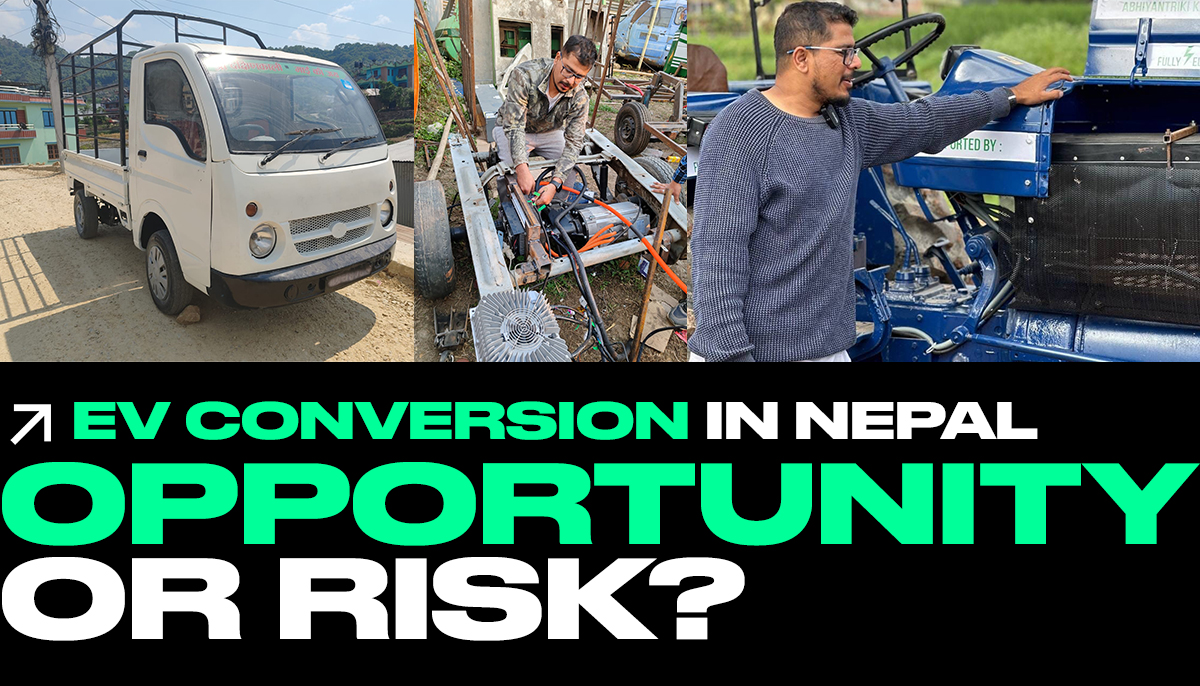
EV conversion is increasingly being positioned as the next big shift in Nepal’s mobility transition—an affordable pathway to cut fuel dependency, extend vehicle life, and accelerate electrification.
But this isn’t a new story.


Nepal has been experimenting with electric mobility for over three decades. Long before global EV supply chains reached South Asia, Kathmandu was already running early electrification efforts.

The Safa Tempo, introduced in 1993 with USAID support, converted diesel three-wheelers into electric public transport long before “EV policy” became a formal agenda. In 1994, Bikash Pandey converted internal combustion vehicles such as the Volkswagen Beetle into early electric prototypes.
The foundation exists. The experimentation is not new. What has changed is scale—and the risk that comes with it.

That shift is where the current debate becomes critical, and it was exactly the framing that came up in a recent conversation with Abhisek Karki, who has been closely engaged with Nepal’s evolving EV conversion ecosystem.
His point was direct: EV conversion is being treated as a mechanical upgrade problem, when in reality it is a regulatory and systems engineering challenge.
Not a Mechanical Swap, but a Systems Problem
One of the most persistent misconceptions in the current EV conversion discourse is the idea that it is a straightforward mechanical replacement—remove the engine, install a motor, fit a battery pack.
As Abhisek emphasized in our discussion, that framing is fundamentally misleading. EV conversion is not a simple component swap; it is a comprehensive systems redesign. It fundamentally alters
- structural load distribution
- chassis stress behaviour
- braking and suspension calibration
- thermal management systems
- high-voltage electrical safety architecture
A converted vehicle is not the same machine with a different power source. It is a re-engineered system operating under entirely new mechanical and electrical constraints.
Battery integration alone introduces high-energy density systems that require strict thermal control, isolation protocols, and Battery Management Systems (BMS) that must interact reliably with emergency shut-offs.
Then comes dynamics. ICE platforms are not designed for instant torque delivery or heavy battery mass distribution. Without proper revalidation of handling and crash performance, conversion shifts from innovation to exposure.
The Policy Gap: Permission Without Protection
Abhisek’s second concern was less about engineering and more about timing. As Nepal moves toward expanding permissions for EV conversion, it is equally important that corresponding regulatory protections are developed in parallel.
If conversion kits enter the market without certification systems, testing protocols, and enforcement mechanisms, the result is predictable: informal workshops, inconsistent engineering practices, and unverified kits operating without accountability.
This is not a theoretical risk. In loosely regulated markets, early-stage failures—battery fires, electrical faults, or structural breakdowns—do not remain isolated incidents. They shape public perception. And in emerging EV ecosystems, a single high-profile failure can stall adoption momentum for years.
The issue is not whether EV conversion should be allowed. It already is. The issue is whether it can be formalized before it scales uncontrollably.
In mature markets like the UK and Australia, EV conversion is treated as regulated engineering practice. It depends on:
- type-approved kits
- licensed workshops
- mandatory post-conversion inspections
Nepal currently has none of these at scale.
Where Conversion Actually Makes Sense
Another key point from the conversation was economic realism.
EV conversion is often framed as a universal solution. It is not. Its viability is concentrated in specific use cases:
- high-mileage commercial fleets
- three-wheelers and delivery vehicles
- municipal and service transport
- select ride-hailing segments
For private passenger vehicles, conversion rarely aligns with lifecycle economics unless heavily subsidized or standardized.
This distinction matters because policy ambiguity here can distort expectations and misallocate both capital and regulatory effort.
The Missing Layer: Human Infrastructure
Beyond hardware, Abhisek highlighted a deeper constraint: capability mismatch.
Nepal’s automotive workforce is still largely ICE-trained. EV conversion demands an entirely different skill stack:
- high-voltage diagnostics
- battery safety systems
- software and controller integration
- electronic drivetrain systems
Without structured certification pathways for technicians, even well-designed policies will fail in execution.
In other words, the limiting factor is not just technology or policy—it is human infrastructure.
The Industrial Opportunity
If structured correctly, EV conversion can evolve beyond a transitional workaround.
A regulated ecosystem would naturally support:
- local battery assembly ecosystems
- component remanufacturing
- testing and certification labs
- advanced EV technical training institutions
This is where conversion becomes more than retrofitting—it becomes industrial groundwork.
Nepal already demonstrated that it can innovate early. The next phase is not invention, but institutional discipline.
Final Perspective
What stood out most from the conversation was a simple reframing: EV conversion is not primarily a technological opportunity—it is a governance test.
The technology already exists. The practice already exists. What does not yet exist at scale is the regulatory discipline to contain and standardize it. So, the real question is not whether Nepal should allow EV conversion.
It is whether it can do so with enough institutional maturity to ensure safety before scale—and structure before speed.
Because without that balance, EV conversion will not necessarily fail because of engineering limits. It will fail because policy and enforcement never caught up with what the market was already doing.